
Introduction
On 2 December 2025 Mike Foley of Cam Valley Forum’s (CVF) Mike Foley presented a talk on river turbidity and its most probable causes at Newnham Croft Social and Sports Club, to an audience with a wide range of interests.
The slides are available here. They have been edited to provide a little more of the details presented verbally at the talk, and this Blog accompanies the slides from the talk. (It is illustrated with a few of the slides, but we recommend you look at the full set of slides too)
This talk is an update on the reports on turbidity published 31 Dec 2022 and 31 March 2025.
The investigations into turbidity were separate from CVF’s monitoring along the Cam and Rhee of faecal indicator bacteria from 2021 which focused on trying to locate the main sources of the organisms. We now know these enter the river continually in fairly high numbers in the discharged, treated effluent at Haslingfield sewage treatment works, and from other locations.
If you have no time to read further, Mike’s conclusion is that soil in suspension is the most probable reason for the turbidity. Downstream of Wendy into Cambridge, turbidity is further exacerbated by the presence and activities of the non-native, invasive American Signal Crayfish, now present in large numbers. The clayey nature of the soil type along the Rhee is one important factor in this river being far more turbid than others in the Cam Catchment.
We suspected this all along, but for reasons that will unfold, we thought it was necessary to investigate other causes. Past dredging, upstream of Wendy, is implicated.
The history
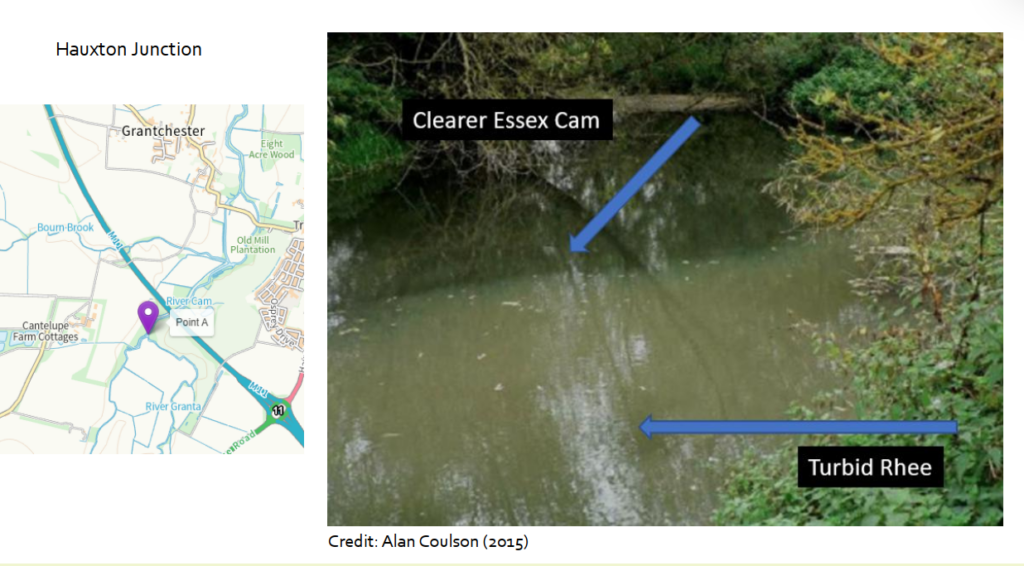
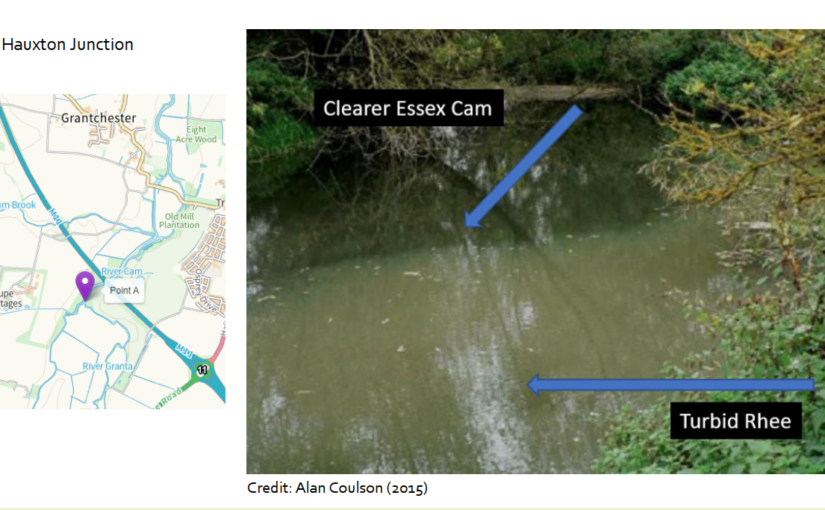
Turbidity is the formal name for murkiness or cloudiness of water. A former CVF committee member and angler Alan Coulson noted in 2015 that something wasn’t right with the Cam. He photographed the Cam at Hauxton Junction where the Essex Cam, also known as the Granta, joins with the Rhee. The Rhee was very murky whereas the Essex Cam / Granta seemed clear.
In early 2022 while Mike was sampling for faecal bacteria and nutrient levels, he realised that lowering the shiny rake vertically into the water was a simple way to measure “depth to invisibility” (DTI). In other words, he could measure how far down he needed to lower the rake until the head became just invisible. He enthusiastically built up a dataset of DTI from various sites over the year and into 2023. When there were sufficient readings from the Byron’s Pool part of the Cam (actually Brasley Bridge) he sorted the results according to low flow and higher flow conditions. Spookily, at low flows, i.e. low-summer flows, turbidity increased as flow decreased. This did not suggest a specific cause but was a good point to start considering options.
Soon, Mike was using a Secchi tube, extended to 165cm length to capture low turbidity events. He also occasionally used the nephelometer Hanna HI-93703 and the Hanna Multiprobe HI-98594, loaned from Hobson’s Conduit Trust, with thanks to Dr Steve Boreham for maintaining their calibrations.
How turbid are the Rhee and Cam?
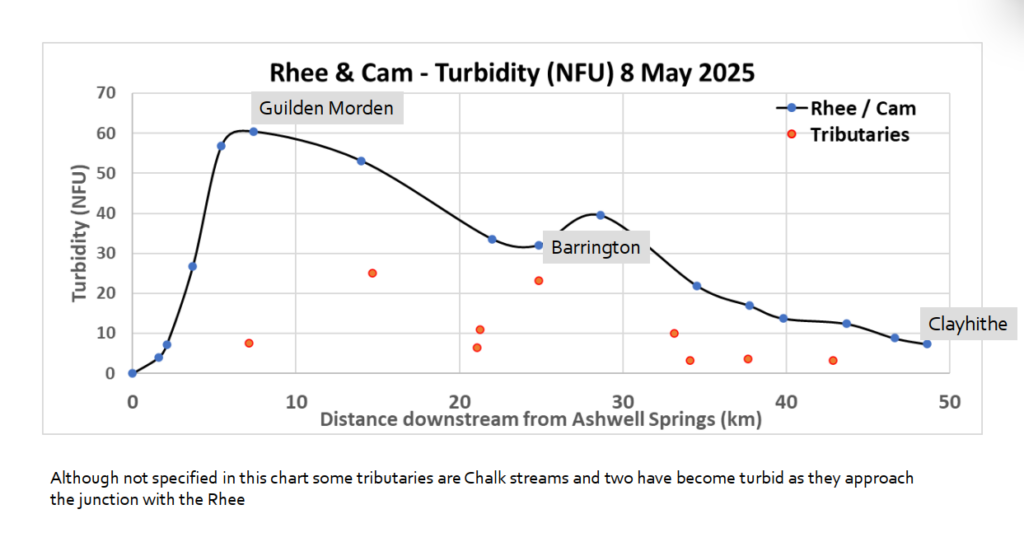
Several monitoring excursions in 2025 have clearly shown that the Rhee is clear at its source in Ashwell, but turbidity can reach very high levels in the upper Rhee, peaking around Whitegates Bridge/ Potton to Guilden Morden road/Tadlow (94 FNU at Tadlow on 20 May 2025). Turbidity then reduces downstream. On the same day, Byron’s Pool’s reading was 25 FNU, but still obviously turbid. Turbidity in summer can rise slightly at further sites around the Haslingfield-Harston road bridge. It is then slightly lower at Byron’s Pool, lower still at Sheep’s Green and very low at Clayhithe.
(Note that NFU “Nephelometric Turbidity Unit” and DTI “depth to invisibility” relate to two different ways of measuring turbidity. A large NFU value (as shown in the graph) indicates high turbidity, whereas a large DTI “Depth to invisibility”, as used elsewhere on this website, implies clearer water)
Local farmers around Tadlow recall the Rhee was clear only a few years ago. Photographs taken in October 2012 near Harston reveal the Rhee appeared clear then, in contrast to its high turbidity of the past few years.
Phosphate / sewage pollution
In 2022, WASP (Windrush against Sewage Pollution) reported, “One common feature of the rivers suffering turbidity issues is sewage pollution and a potential link with high phosphate inputs from STWs.” Could these be a major cause of our turbidity? The answer seems to be no.
For instance, the highest turbidity in 2025 was measured along the Rhee near Tadlow where CVF sampling showed that stretch had the lowest phosphate (<0.084 mg/l) of the entire river. Furthermore, CVF monitoring of the Rhee and Cam for phosphate in 2021/2022 from Harston showed no decrease in concentration at the lowest part of the Cam we monitored – Clayhithe (mean of three samples, 0.442 mg/l orthophosphate-P). Yet Clayhithe had the clearest water of the entire Cam.
There exists a particulate whitish chemical called “Struvite” which contains phosphate. This forms when there are equi-molar amounts of ammonium, magnesium and phosphate present – MgNH4PO4.6H20 – and it can form at sewage works. Routinely Mike sampled effluent at several works and using either a Secchi tube or nephelometer, and if struvite was present in sufficient amounts it would show up. One sampling at Haslingfield STW on 30 April 2025 coincided with a storm overflow, and resulted in the following turbidity readings (FNU): (a) treatment using filtration beds, 5.15. (b) treatment using the activated sludge tank, 1.07. (3) pure storm overflow from storm tanks, 7.45. These readings show that the effluent turbidity so far too low to be a contributor, on that occasion. Furthermore, Mike has compiled readings that show effluent at other works can be remarkably clear, though there is usually some small amounts of natural brown particulate matter present, called “floc”, that is part of the treatment process. For instance, Melbourn and Linton STW effluent can be so clear that after filling the entire 165cm long Secchi tube with effluent the Secchi disk at the base of the tube is still visible.
Thus, treated sewage (also the storm overflow above) at the numerous Anglian Water sewage works discharging into the Rhee, Cam or tributaries appear not to contain sufficient particulates to contribute to high river turbidity.
Nor do measurements of the effluent reveal levels of bacteria high enough to cause a turbid “soup”. Also, it’s not in the nature of naturally occurring aquatic true bacteria in a flowing river to form soups sufficiently turbid to explain what we have been seeing.
Algal blooms
Cyanobacteria (blue-green algae) can create turbidity – this has occurred recently at Todd’s Pit at Milton Country Park – but high power microscopical examination of Rhee water show no cyanobacteria in large numbers.
In recognition that the Cam sometimes appears green, a Turner Aquafluor detector of green algal Chlorophyll a was loaned in 2024 from the Zoology Department, Cambridge University. Samples from sites on the Rhee and Cam where the water was grey-brown were found to have zero amounts of Chlor a. No river samples were green.
Suspended soil
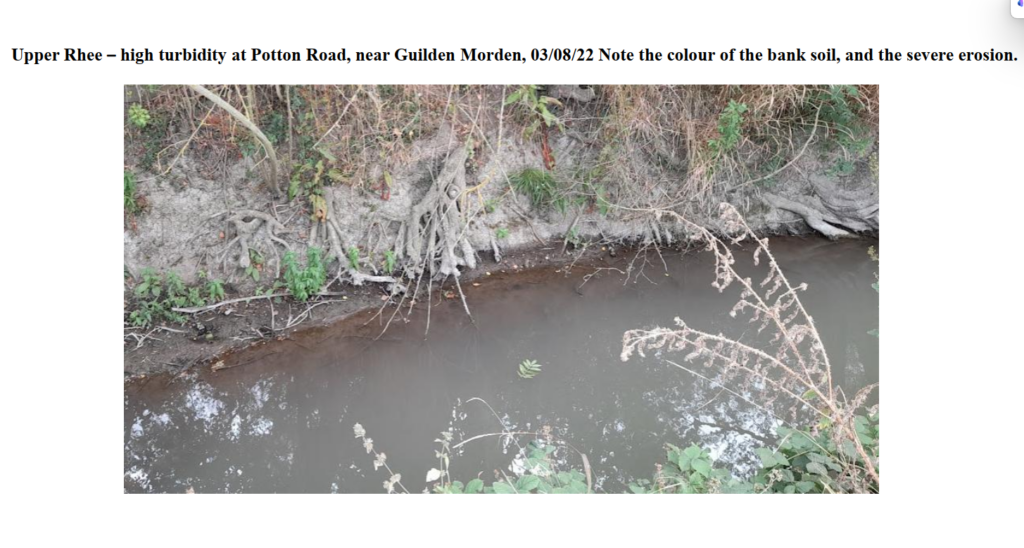
Soil appears to be the culprit. It cannot be coincidental that the colour of the arable soils in the upper Rhee and the Rhee banks have some greyish hue in them that matches the colour of the river water in the summer. Mike has passed on samples to Dr Steve Boreham of WildReach.co.uk who confirms that they contain soil. However, it is not all soil – there is also some organic matter and particulate calcium carbonate.
It seems that only small amounts of soil are needed to create turbid conditions. It could be soil resuspended from the river bed, etched out of the bank, or newly arrived via arable ditchworks or directly from fields into the river. The puzzle still to solve is how turbidity in the upper Rhee persists during periods of dry conditions when ditches are dry and there is no runoff from fields. It appears that only small amounts of soil released into the water are needed to make the river turbid.
It seems reasonable to ponder that suspension of extremely fine clay into the water at one point will not persist too far downstream. Perhaps it is only 50m, depending of soil particle size. But if uplift is happening at one point, it will also be happening a little further downstream, but from this second point the soil will be carried a little further on, and so on.
A controversial issue is the dredging of the Rhee to reduce the risk of overtopping during high winter rainfall. Dredging may expose fresh layers of clay that can lift more easily into the water.
American Signal Crayfish
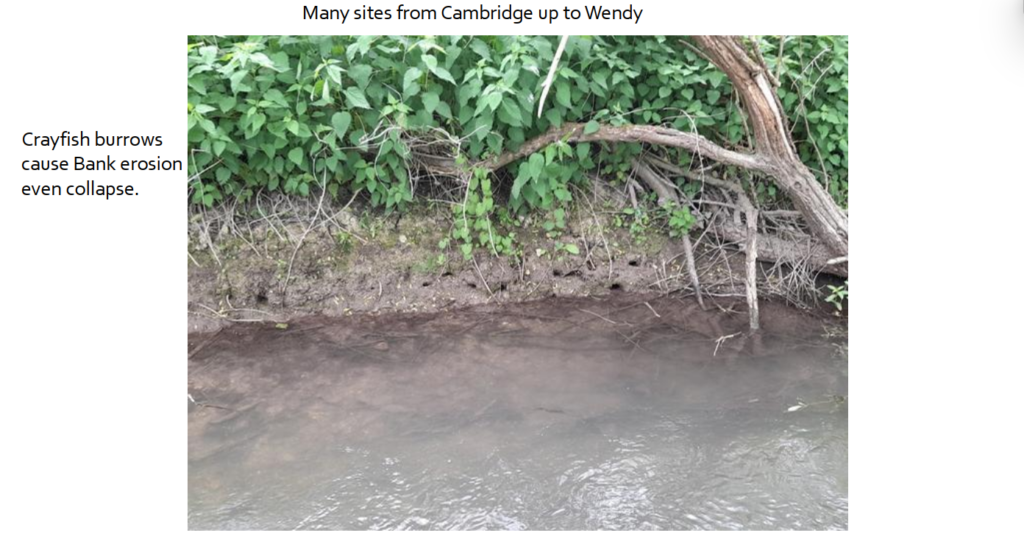
In 2023, Mike saw persistent high turbidity in the Cam during the summer when for weeks there was no appreciable rainfall to drive soil from ditches or arable fields into the river. The tributary Bourn Brook was actually fairly clear compared to the Cam and thus not a major contributor. Some Chalk streams were slightly turbid but not enough to increase turbidity of the Rhee and Cam. In fact, they would be diluting the turbidity
The simple answer to turbidity in dry spells seems to be American Signal Crayfish. This invasive crayfish has been shown markedly to increase turbidity. Populations can be large: over 1600 crayfish of all sizes and age were taken out of a Yorkshire beck headwater just from a 10m stretch. Largely active nocturnally they stir up bed sediment while fighting and feeding, and when capturing and eating juveniles, and tunnel into the bank up to 200cm depth (mostly up to 60cm on the fish pass at Byron’s Pool). The excavations must allow continuous suspension of soil, whilst mature tunnels cause erosion, sometime causing bank collapse.
The Environmental Agency has concluded that that the turbidity of both the Windrush and parts of the Rhee involves the presence of American Signal Crayfish.
Mike has noted increasing turbidity in the Granta and the Essex Cam / Granta at Hauxton Mill. Crayfish are populating more stretches of our rivers (and are common at Hauxton Mill) and as tagging has shown that they can march 100m upstream overnight, he foresees invasion forces moving steadily towards the headwaters. Numbers may be very low at the front of the invasion – however, it has been proposed that only one female and one male need to be present in stretch of 200m if the stream is 5m wide to be the Minimum Viable Population Density, usually undetectable. Over future years we will see more colonisation, and probably therefore even higher turbidity levels where the geological base of the soil in that stretch is of the right type to be suspended.
Conclusions
- No evidence that the prolonged turbidity is caused by algal blooms
- Not obviously sewage works related
- Not a direct phosphate effect
- Upper Rhee – probably soil alone
- Lower Rhee and Cam – soil + American Signal Crayfish
- The geological soil type seems pivotal in determining how turbid the water becomes from soil suspension.
- Local farmer perceptions reveal the upper Rhee was not nearly so turbid just a few years ago. Some light dredging in the upper Rhee may be part of the cause.
Actions
- Reduce soil runoff from arable fields into ditches or direct into the rivers
- Discontinue any dredging of the rivers (when possible)
- Reinforce bank sides
- Need for scientists to devise a control measure for the crayfish
- Trapping of crayfish to reduce populations needs to be thorough and not just removal of adults. A near-impossible task on large stretches of the Rhee and Cam.
- Testing of the upper Rhee with environmental-DNA specific to American Signal Crayfish to determine how much of the Rhee around Tadlow it has colonised.